The Work

Built end to end.
Adopted beyond the district.

Fifteen years of builds: what was broken, what she made, and what happened next.

OPERATIONS

$6.4M16,066 assets inventoried

37 central office 68 media specialists

The district asset-inventory program

Problem
A district running tens of thousands of devices across 57 schools needed one accountable inventory, and the systems and training to keep it accurate.
Build
Built every phase of the inventory program in Booktracks, authored its training guides, and trained 37 central-office staff and 68 library media specialists to run their pieces of it.
Proof
16,066 physical assets inventoried, $6.4M in value, October 2025 through June 2026. The same operational muscle runs the district's device refreshes: 1,556 elementary teachers in one spring, coordinating about 12 technicians alongside her 8-person team.
IDENTITY & ROSTERING

61apps rostered · ready on day one

61 apps rostered her direct contact: 36

Rostering and identity, 61 apps deep

Problem
Every digital tool a district buys is useless until the right students and teachers appear inside it, in the right classes, on the first day of school. Rostering is the invisible plumbing under all of it.
Build
She runs ClassLink rostering for the district's apps (everything except two design suites), coordinating a rostering process that involves roughly 30 people across departments and vendors. She is the named technology contact for 36 of the 61 rostered applications, and she turned the district login itself into a student design competition, ClassLink Launchpad Legends, that 10 US districts reached out about.
Proof
61 applications rostered through ClassLink and Clever, ready on day one. The daily, unglamorous work that decides whether every other tool in the district functions.
ANALYTICS

+51%coaching visits in one year

556 840

The coaching analytics tracker

Problem
Instructional coaching happened, but the district could not see it: visit tracking was scattered, and the program's value was invisible in budget conversations.
Build
Coaching-visit tracking rebuilt into a Looker Studio analytics tracker, with the state's Technology in Motion specialists brought in to train the team on it.
Proof
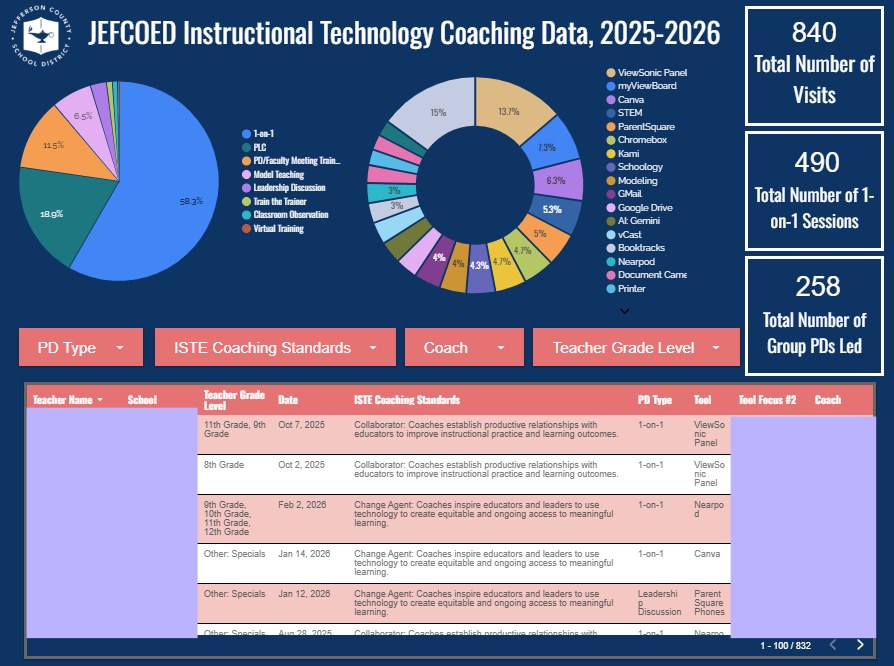
Visits grew from 556 to 840 in one year; PLC and group sessions grew from 30 to 258. Four other Alabama districts adopted the tracker through ALET visits, and the same dashboard held its own in Title II budget meetings, where it helped keep the federally funded coaching positions and fund a classroom VR set.
The live coaching analytics dashboard: PD-type and tool breakdowns, 840 visits, 490 one-on-one sessions, 258 group PDs
The dashboard itself, 2025-26: 840 visits, 490 one-on-ones, 258 group PDs (identifying columns left blank)
AI GOVERNANCE

99%pass rate · 2,083 completions

99% 2,083 staff certified on first pass rate

District AI policy and mandatory training

Problem
AI arrived in classrooms before the district had a policy, a procedure, or a workforce trained to use it responsibly.
Build
Co-authored the district's AI policy and procedure with the deputy superintendent and the technology director, then authored and led all of the mandatory AI responsible-use training, with Gemini access switching on 24 hours after an employee passed. Brought in a Google Innovator group for roughly 15 pre-launch calls and two days of administrator training.
Proof
2,083 completions at a 99% pass rate. The district turned AI access into something earned through training rather than switched on by default.
ACCESSIBILITY

~150AAC devices, crisis to inventoried

crisis managed

Accessibility and the AAC device program

Problem
On her first day as Assistant Director she inherited a crisis: roughly 150 assistive-communication iPads collected and never inventoried, about 50 of them no longer security-supported, and the students who depend on them waiting.
Build
A crisis ordering plan, an on-the-fly screen-lock system to tell speech-therapy and AAC devices apart, Mosyle management for the fleet, priority ticket routing, and training for the AAC specialist. Years earlier she was the architect of the district's first Chromebook accessibility guides, and she now requires every coach to surface screen-reader options in training. She also built a Gemini tool that checks guides against accessibility standards and suggests alt text.
Proof
Roughly a year later, every AAC device is inventoried centrally and the team is trained. Accessibility is a through-line of the program, not a side project.
PROGRAM LEADERSHIP

21presenters · 138 registrations · 2026

13 12 15 21

PowerEDUp!, the district's educator technology conference

Problem
A young annual conference with no formal processes behind it: no documented vision, schedule system, sponsorship pipeline, or presenter program.
Build
Took the lead in 2025, the conference's fourth year, and created its first formal processes: vision, scheduling, sponsorship and vendor negotiation routed through the district foundation, a presenter program, the Digital Playground, and a Looker Studio conference program.
Proof
Under her lead: 15 presenters and 111 registrations in 2025, then 21 presenters and 138 registrations in 2026. She owns the sponsorship budget and negotiation end to end.
DATA GOVERNANCE

221supported resources, publicly tracked

221 supported 67 unsupported

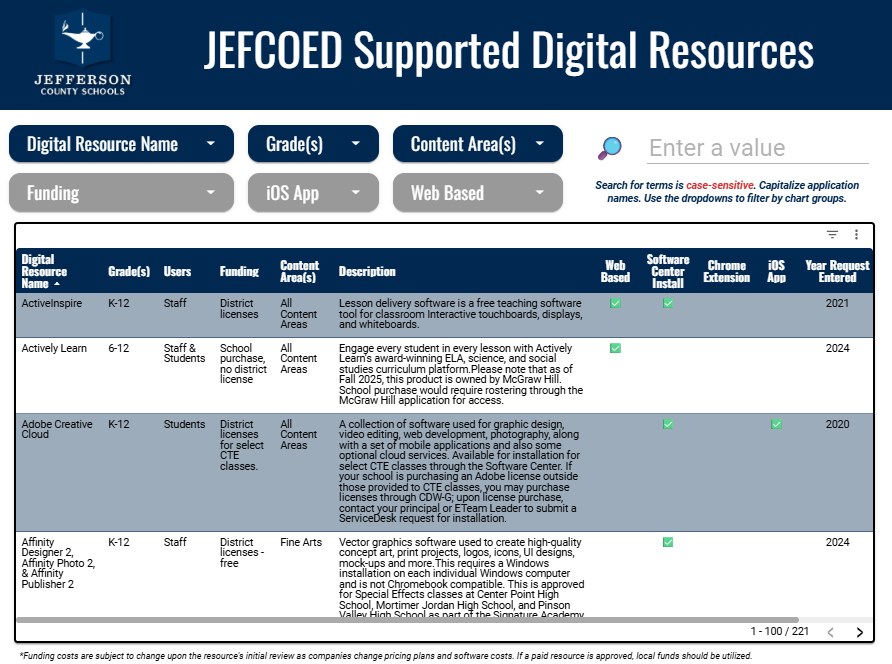
The public Digital Resource Dashboard

Problem
The district's approved-resource list lived in a published spreadsheet nobody could actually use: unsearchable, unclear, and silent on why tools were denied.
Build
A searchable public Looker Studio dashboard she rebuilt herself, working out the filter code on her own: supported and unsupported tabs, denial dates and rationale, and a resubmission link. It tracks 221 supported and 67 unsupported digital resources.
Proof
Presented by the Alabama State Department of Education as a data-governance best practice. A Georgia district adopted the process, and she helped a New Mexico specialist and a Massachusetts innovator replicate it. Shared at least four times at statewide conferences.
The public JEFCOED Supported Digital Resources dashboard
The live public dashboard: 221 supported resources, searchable by anyone
AI + PRIVACY

5districts run it: 4 Alabama + 1 Georgia

AL AL AL AL GA

The AI-driven privacy vetting tool

Problem
Digital Resource Committee compliance review meant manually checking roughly 140 requests a year against overlapping standards: NIST, state data-privacy agreements, state AI guidance, and 1EdTech rubrics.
Build
An internal AI-driven vetting tool, built on NotebookLM, that amalgamates all four rubric families into one automated review. She authored the AI-guidance rubric that runs through the tool.
Proof
Adopted by four Alabama districts and one Georgia district through a Google Southeast PLC, and demoed on request. Compliance review that once consumed committee time now runs through the tool.
MOUNTAIN BROOK · SECURITY

Highest to lowestdistrict phishing-click rank, one school year

highest lowest

The security-training turnaround

Problem
As Cherokee Bend Elementary's technology coordinator at Mountain Brook Schools, she inherited the district's highest phishing-test click rate.
Build
A staff security-training program built on the NIST Cybersecurity Framework: custom one-on-one training plus monthly campaigns. She became the first coordinator in the district to earn the CCRE cybersecurity credential, then helped two colleagues pass theirs.
Proof
Highest click rate to the lowest in the district, in a single school year.
NASHVILLE · INSTRUCTION

8teachers led in a multiclassroom model

average +20%

The multiclassroom literacy model

Problem
One strong teacher's ceiling is one classroom. At Bailey STEM Magnet in Metro Nashville, the district needed literacy gains across many classrooms at once.
Build
As multiclassroom instructional leader she managed 8 literacy and social studies teachers, wrote the lesson plans delivered across their classes, built all the common formative assessments, ran weekly data meetings, and designed a tier 1/2/3 intervention rotation.
Proof
Credited with leading students to 20% above-average growth on the state assessment, and rated a Tennessee Level 5 educator, the top tier, by her second year.

Product decisions, made with data

  • Retired Project Lead the Way by gathering the adoption and support data and handing it to the gifted specialist who made the call.
  • Narrowed a six-vendor VR pilot to one approved product, then piloted it across 47 classes reaching 940 K-5 students.
  • Moved the district off at least two products using ticket and usage analytics.
  • Launched Circool at Mountain Brook Schools, where as the local technology coordinator she was the first in the district to bring in the K-12 school-event ticketing platform, training staff and students on it.
  • Designed the ClassLink Launchpad Legends competition for students to redesign the district login; 10 US districts reached out about the model.

Before the district office

  • District Secondary Teacher of the Year, 2019-20, at Shelby County Schools, teaching roughly 480 students of 7th and 8th grade English.
  • Built a school-wide advisory website with weekly SEL and digital-literacy lessons she designed, used by about 60 teachers and 1,200 students.
  • Won five competitive grants as a teacher, including a $5,000 international fellowship awarded to about 25 educators worldwide.
  • Onboarded Teach For America graduates from 15 states and led Google Meet training for about 75 people as a virtual pre-service manager.
  • Coached 12 first-year teachers across Alabama's Black Belt in nightly virtual sessions while working full time as a technology coach.